A Good Health App Can Say "I Do Not Know"
Many apps are built to always have an answer: a score, a prediction, a confident colour on the screen. It feels helpful. In health, it can be the opposite.
The problem with a confident guess
Health is full of things that nobody can know from a phone. A number that looks precise but rests on three days of data is not information; it is decoration. A reassuring green that hides how little the app actually knows can send someone away from a question they should have asked.
We would rather an app say less and be right about what it says.
Three habits of an honest health app
1. Show what was measured, and what was only estimated. A reading the person entered, a pattern the app inferred and a prediction about the future are three different things. Label them differently.
2. Say plainly when the data is too thin. "We need a few more weeks of entries before we can show a pattern" is a better sentence than a chart that looks complete. It also tells the user what to do next.
3. Point to a qualified person when the question is bigger than the app. A wellness app can help someone organise what they notice and prepare for an appointment. It should not pretend to replace one.
Why this builds trust
People forgive an app for not knowing. They do not forgive it for pretending. The first time an app admits a limit, the user learns that its other statements can be believed. The first time it pretends there is no limit, that lesson runs the other way.
How we apply it
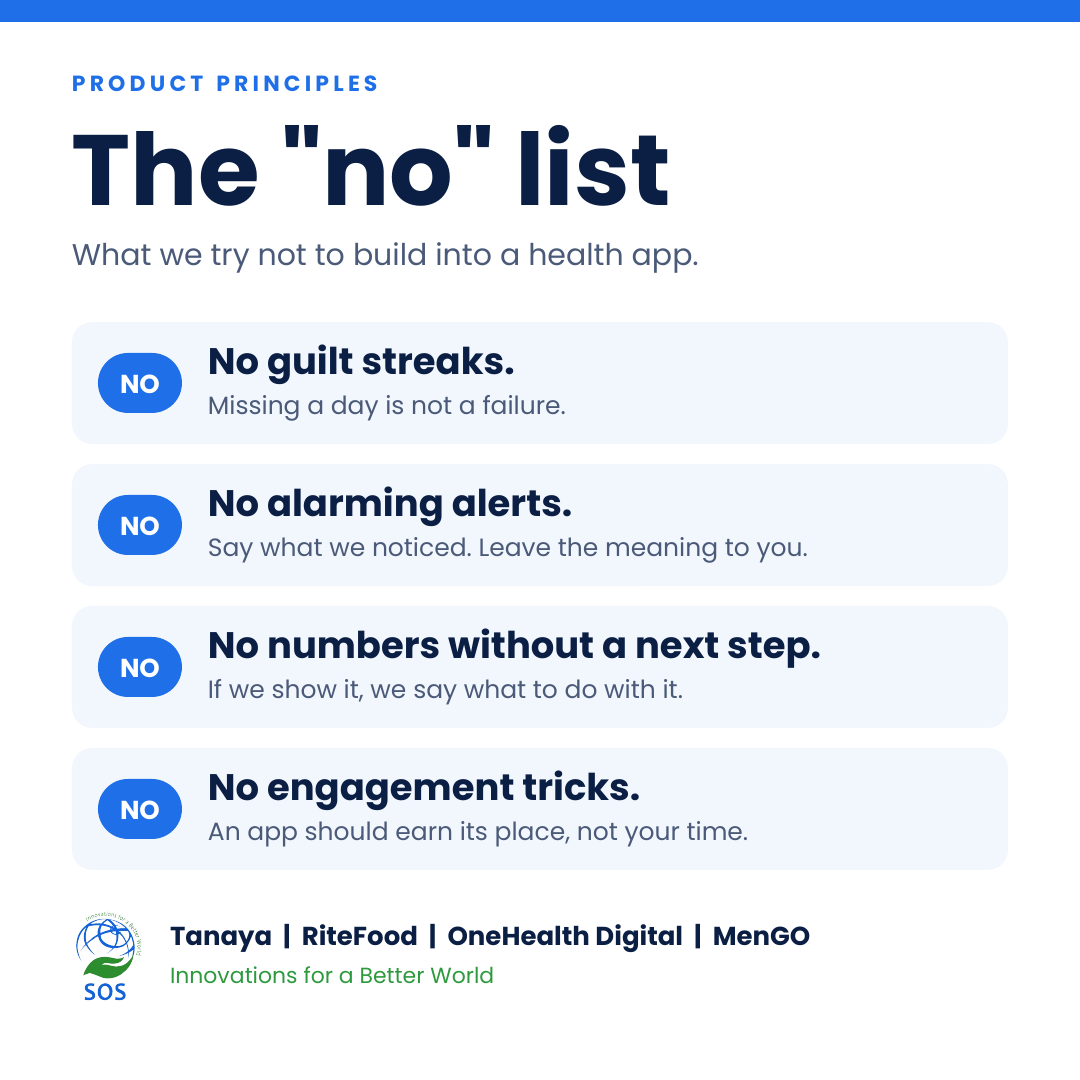
Across Tanaya, RiteFood, MenGO and OneHealth Digital, we hold ourselves to the same plain rule: say what we know, say how we know it and say when we do not. Our apps are wellness and information tools, not medical advice, and we try to write every screen so that this is clear without being buried.
If you have used a health app that was refreshingly honest with you, we would like to hear what it said.