
We Gave Our Apps a Performance Review. Here Is What We Measure Instead of Screen Time.
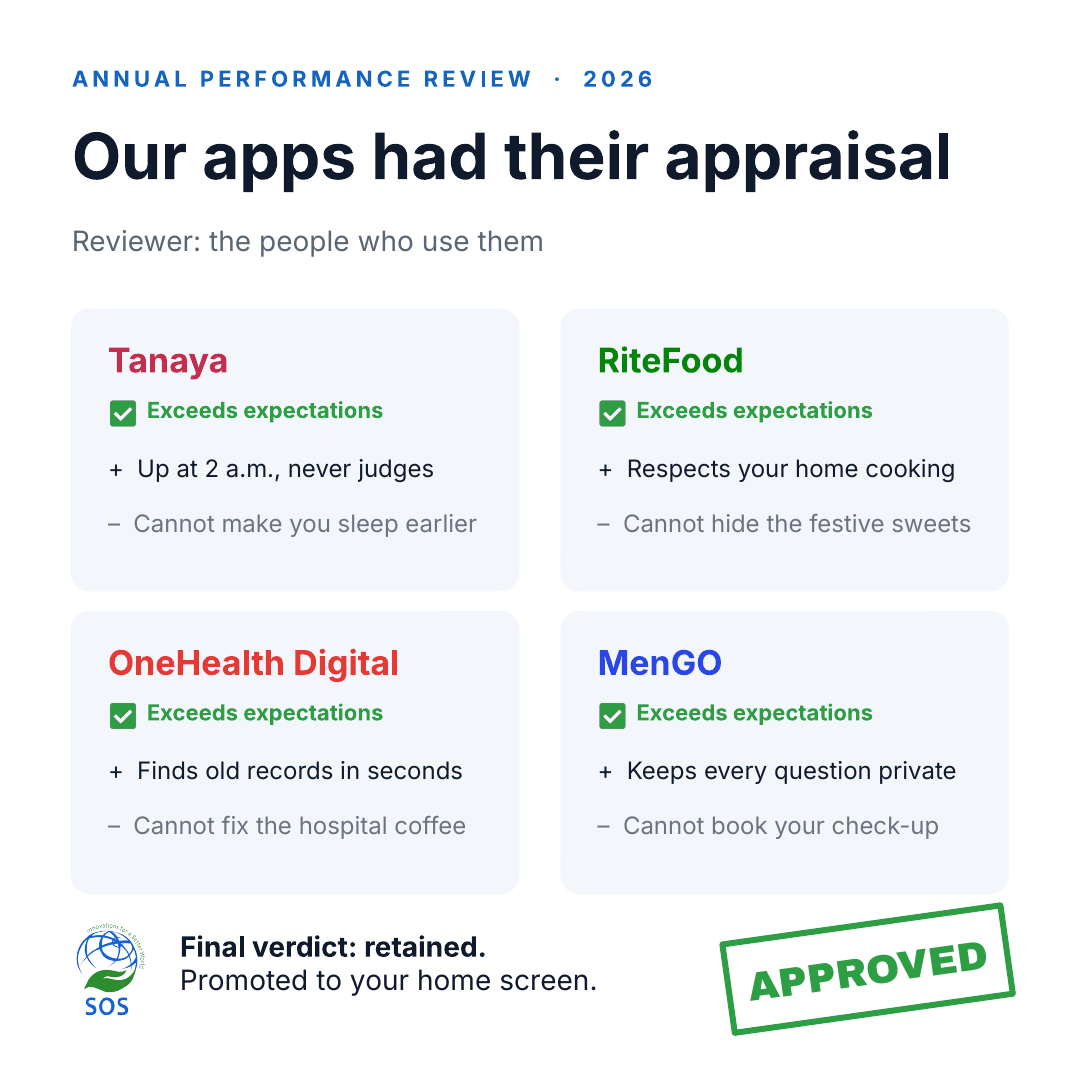
Every year, teams sit down for appraisals. Strengths, areas for improvement, a rating, a decision. This year we tried the same exercise on our products, and wrote a review for each of our apps as if it were a member of the team.
It started as a joke. It turned into a useful conversation about what "good" actually means for a health app.
The reviews
Tanaya, women's wellness. Exceeds expectations. Up at 2 a.m., never judges. The 24/7 wellness assistant answers the questions people are not ready to ask anyone else, and the monthly summary turns scattered notes into something a doctor can use. Area for improvement: it still cannot make anyone go to bed earlier.
RiteFood, personalized nutrition. Exceeds expectations. Respects home cooking. It builds meal plans around the dishes and cuisines people already eat, instead of asking them to start over. Area for improvement: it cannot hide the festive sweets.
OneHealth Digital, the platform for hospitals and clinics. Exceeds expectations. Finds a six-month-old patient record in seconds, with appointments, reminders and follow-ups in the same place. Area for improvement: it has no control over the hospital coffee.
MenGO, men's personal health. Exceeds expectations. Keeps every question private and points to qualified specialists when it is time to take the next step. Area for improvement: it cannot book the check-up for you.
The metrics we chose not to use
Most consumer apps are judged on attention. Daily active users, session length, streaks, notifications opened. For a game or a social network, that may be the right scoreboard.
For a health app, we think it is the wrong one. Nobody wants to spend their evening inside a period tracker, a diet log or a clinic dashboard. A long session can just as easily mean that someone is confused, or searching for something that should have been obvious.
So when we review our apps, we ask different questions.
What we measure instead
Clarity. After using the app, does the person understand something about their health that they did not before? A summary that nobody can read is not a feature.
Time to answer. How quickly can someone log what they need, find what they are looking for, and get back to their day? For OneHealth Digital, that means how long a front desk takes to pull up a returning patient. For Tanaya and RiteFood, it means how many taps it takes to log a day.
A practical next step. Every screen should lead somewhere: a recipe to cook, a pattern to watch, a question to bring to a doctor, a specialist to book. Information that leads nowhere is noise.
Trust. Does the app speak plainly, avoid alarming people, and stay honest about what it is? Our consumer apps are wellness and information tools, not a substitute for professional medical advice, and they say so.
Language. Health guidance only helps if people can read it. Tanaya and RiteFood support eight languages, and we treat that as a core requirement, not an extra.
Who the real reviewers are
We can write all the self-assessments we like. The reviews that count come from the people who use these apps every day: women tracking their cycles, families planning meals, hospital administrators running a busy morning, men looking for a private place to start.
Their feedback decides what we build next. If you use any of our apps and have a note for its next appraisal, we would like to hear it. Find them on our Google Play developer page: https://play.google.com/store/apps/developer?id=SystemOnSilicon+Corporation
Final verdict: retained, and still improving.