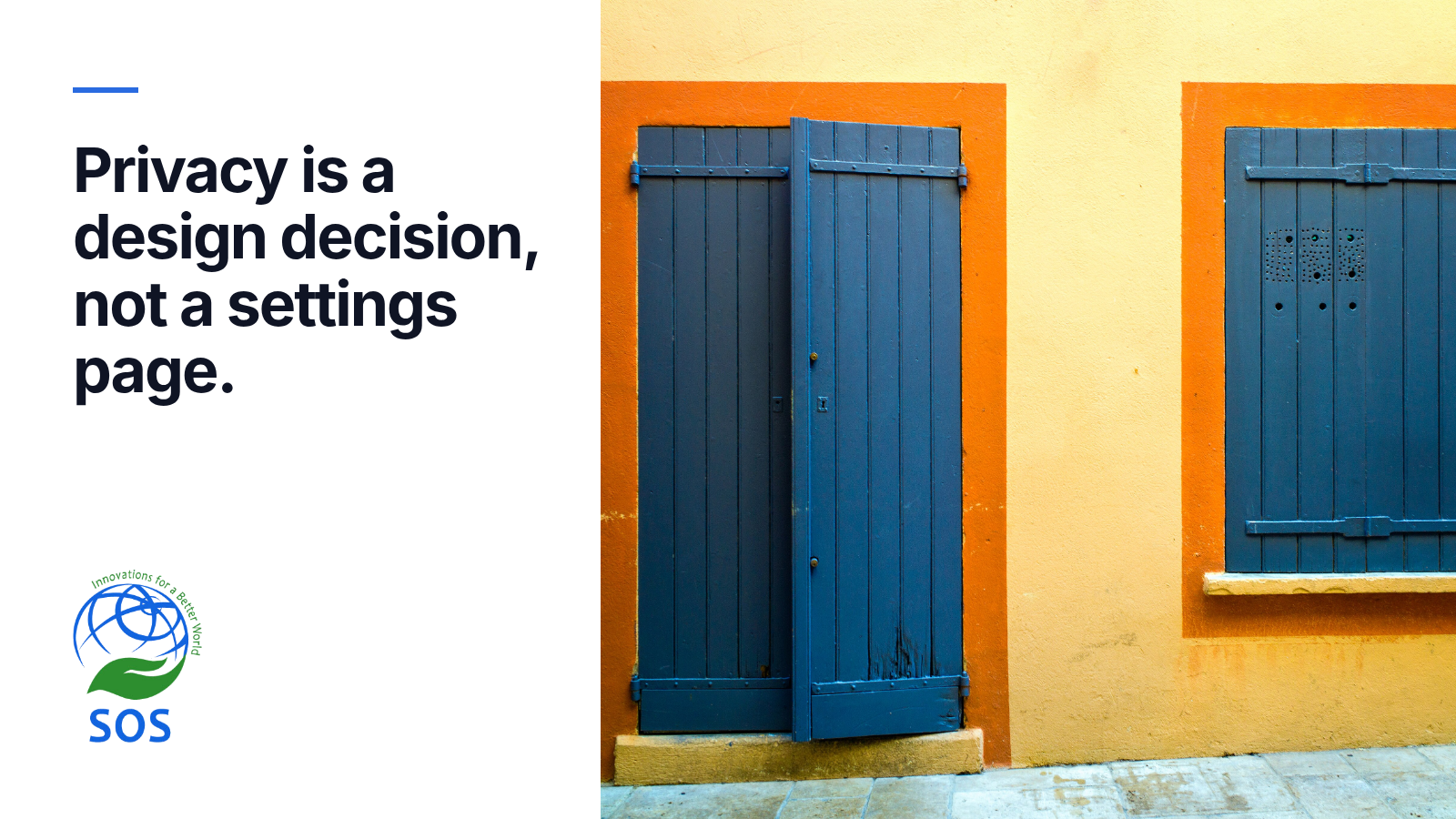
Privacy Is a Design Decision, Not a Settings Page
Open the settings of most apps and you will find a privacy section: a list of toggles, a long policy and a button that says Accept. It looks like control. Often it is the last step of a product that was designed without privacy in mind.
For health technology, that order is backwards. By the time a user reaches the settings, the important decisions have already been made.
The decisions that matter come first
Privacy is decided when a team chooses what to collect, where it is stored, who can see it and how long it is kept. These are design decisions, taken long before any toggle is drawn. A setting can only switch off what the product already allows.
A good test: if a feature cannot work without a piece of data, say so plainly. If it can, do not ask for the data at all.
Four questions we ask before building
- Do we need this? Every field we collect is a field we must protect. If a feature works without it, we leave it out.
- What is the default? Most people never change defaults, so the default is the real policy. The private choice should be the one you get without doing anything.
- Who can see it, and can the user tell? Sharing, such as a summary for a doctor, should be an explicit action by the user, easy to understand and easy to reverse.
- How does it end? A person should be able to remove their data, and the product should be built so that removal actually works, rather than being a request that waits in a queue.
Plain language over legal language
A privacy policy has to be accurate, but accuracy is not the same as being understood. We try to explain what a feature does with personal information in the screen where the feature lives, in a sentence a tired person can read in five seconds. If we cannot explain it simply, that is a sign the design needs another look.
Honest limits
No product is private by magic. What we can do is be clear about what we collect, why, and what we have chosen not to do. That clarity is part of the product, in the same way that good writing and clean layouts are.
Our apps, Tanaya, RiteFood, MenGO and OneHealth Digital, serve different people, and each handles different kinds of information. The questions above are the same for all of them.
If you are building health technology, a good place to start is an uncomfortable meeting: list everything your product collects, and next to each item write the feature that cannot work without it. Whatever is left without an answer is a candidate to remove.
Learn more about our products at https://www.systemonsilicon.com.